
Major Currency Pairs Explained: What You Need to Know
Major Currency Pairs Explained: What You Need to Know The foreign exchange (forex) market is the largest and most liquid financial market in the world, with trillions of dollars traded every single day. At its core, forex trading involves buying one currency while simultaneously selling another — which is why currencies are always quoted in […]
Major Currency Pairs Explained: What You Need to Know
The foreign exchange (forex) market is the largest and most liquid financial market in the world, with trillions of dollars traded every single day. At its core, forex trading involves buying one currency while simultaneously selling another — which is why currencies are always quoted in pairs.
Among all the currency combinations available, there is a specific group known as the major currency pairs. These pairs dominate the market, offer the best trading conditions, and are the starting point for every new trader. In this guide, we will explain exactly what major currency pairs are, how they work, what moves their prices, and why they should be your first choice when starting your trading journey.
Why Start With Majors? Major currency pairs make up around 70–80% of all trading volume in the forex market. High liquidity means tighter spreads, faster execution, and lower transaction costs — making them ideal for both beginners and experienced traders.
How Currency Pairs Work
Before looking at specific pairs, it is important to understand the structure of a currency quote. Every pair consists of two currencies:
- Base Currency: This is the first currency listed in the pair. It represents what you are buying or selling. For example, in EUR/USD, the Euro is the base currency.
- Quote Currency: This is the second currency listed. It shows how much of this currency is needed to buy one unit of the base currency. In EUR/USD, the US Dollar is the quote currency.
Example Quote: If EUR/USD is priced at 1.0950, it means 1 Euro equals 1.0950 US Dollars.
When you trade a currency pair, you are essentially betting on whether the base currency will strengthen or weaken against the quote currency. If you believe the base currency will rise, you buy the pair; if you think it will fall, you sell it.
What Defines a “Major” Currency Pair?
For a currency pair to be classified as a major, it must include the US Dollar (USD) and one of the other most economically powerful currencies in the world. The US Dollar is involved in nearly 90% of all forex transactions, which gives it a central role in the global financial system.
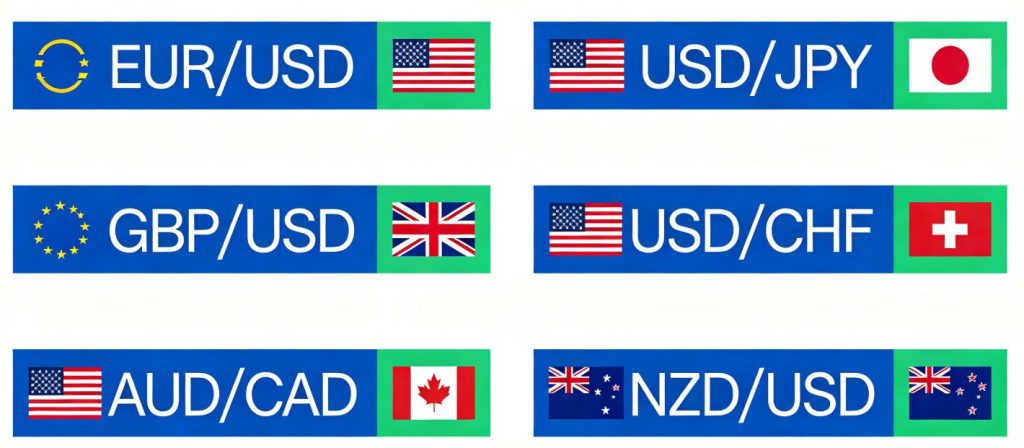
There are only seven currency pairs that are universally recognized as the majors. Let’s look at each one in detail:
1. EUR/USD — Euro vs. US Dollar
Also known as “Fiber,” EUR/USD is the most traded currency pair in the world, accounting for roughly 25–30% of total daily trading volume. It represents the two largest economies: the European Union and the United States.
- Key Influences: Interest rates set by the European Central Bank (ECB) and the Federal Reserve (Fed), inflation data, GDP growth, and political stability in the Eurozone and US.
- Characteristics: Typically has the tightest spreads and high liquidity, making it very stable and predictable for most trading styles.
2. USD/JPY — US Dollar vs. Japanese Yen
Known as “The Gopher,” this is the second most traded pair. It is popular among traders looking for strong trends and is heavily influenced by interest rate differences between the two countries.
- Key Influences: Monetary policy from the Federal Reserve and the Bank of Japan, economic growth in Asia, and global risk sentiment. The Yen is often seen as a “safe-haven” currency.
- Characteristics: Can move in strong, sustained trends and is sensitive to changes in global stock markets.
3. GBP/USD — British Pound vs. US Dollar
Called “Cable,” this pair has a long history and is very popular among traders. It represents the economies of the United Kingdom and the United States.
- Key Influences: Decisions from the Bank of England and the Federal Reserve, inflation, employment data, and political events such as elections or trade agreements.
- Characteristics: Tends to have higher volatility than EUR/USD, which creates opportunities but also carries higher risk.
4. USD/CHF — US Dollar vs. Swiss Franc
Known as “The Swissie,” this pair links the US Dollar with the Swiss Franc — another major safe-haven currency.
- Key Influences: Interest rates, global economic uncertainty, and the policy of the Swiss National Bank. During times of market stress, traders often move money into the Franc.
- Characteristics: Often moves in the opposite direction of EUR/USD and is considered a stable pair, though with slightly lower volume than the top three.
5. USD/CAD — US Dollar vs. Canadian Dollar
Nicknamed “The Loonie,” this pair is closely tied to commodity prices, especially oil, since Canada is one of the world’s largest oil exporters.
- Key Influences: Crude oil prices, interest rates from the Bank of Canada and Federal Reserve, and trade relations between the US and Canada.
- Characteristics: Strong correlation with energy markets, making it easier to analyze if you follow commodity trends.
6. AUD/USD — Australian Dollar vs. US Dollar
Called “The Aussie,” this pair is heavily influenced by trade and commodity prices, as Australia is a major exporter of minerals, metals, and agricultural products.
- Key Influences: Prices of iron ore, gold, and coal, interest rates from the Reserve Bank of Australia, and economic conditions in China — Australia’s largest trading partner.
- Characteristics: Often moves in line with global growth trends and commodity markets.
7. NZD/USD — New Zealand Dollar vs. US Dollar
Known as “The Kiwi,” this pair is similar to the Aussie but on a smaller scale. New Zealand’s economy relies heavily on agriculture and dairy exports.
- Key Influences: Dairy prices, interest rates from the Reserve Bank of New Zealand, and demand from Asian markets.
- Characteristics: Slightly lower liquidity than other majors but still very accessible and popular.
Quick Comparison of Major Currency Pairs
| Currency Pair | Nickname | Main Drivers | Volatility Level |
|---|---|---|---|
| EUR/USD | Fiber | Interest rates, EU/US economy | Low to Moderate |
| USD/JPY | Gopher | Interest rates, risk sentiment | Moderate |
| GBP/USD | Cable | Economy, politics, trade | Moderate to High |
| USD/CHF | Swissie | Safe-haven demand, rates | Moderate |
| USD/CAD | Loonie | Oil prices, trade | Moderate |
| AUD/USD | Aussie | Commodities, China demand | Moderate |
| NZD/USD | Kiwi | Agriculture, trade | Moderate |
Why Trade Major Currency Pairs?
For new traders, focusing only on major pairs is the smartest choice. Here is why:
- High Liquidity: There are always buyers and sellers available, so you can enter or exit trades quickly without worrying about getting stuck.
- Lower Costs: Because of high trading volume, spreads are usually the smallest, which reduces your overall trading expenses.
- More Information Available: There is plenty of news, analysis, and research available for these pairs, making it easier to study and understand price movements.
- Stable Movement: Majors tend to move in more predictable patterns compared to exotic pairs, which can have sudden, unpredictable swings.
Tips for Trading Major Currency Pairs
- Start with one or two pairs: Do not try to trade all seven at once. Begin with EUR/USD or USD/JPY, learn how they move, and expand slowly.
- Follow the economic calendar: Major pairs react strongly to news releases such as interest rate decisions, inflation reports, and employment data. Always know when these events are scheduled.
- Choose a reliable platform: To trade these pairs with fair conditions and accurate pricing, you need a trusted provider. If you are comparing options and looking for reliable details, you can visit broker reviews and ratings to find platforms that offer competitive spreads and good execution for major currency pairs.
- Watch for correlations: Some pairs move in similar ways (e.g., EUR/USD and GBP/USD often move together), while others move opposite (e.g., EUR/USD and USD/CHF). Understanding this helps you avoid taking too much risk in the same direction.
- Combine with analysis: Use technical tools like moving averages or support/resistance levels, along with fundamental news, to improve your trading decisions.
Final Thoughts
Major currency pairs are the foundation of the forex market. They offer the best balance of liquidity, cost, and predictability, making them the perfect starting point for any trader. By understanding what each pair represents, what drives its price, and how it behaves, you will be able to build a clear and focused trading strategy.
Remember, successful trading is not about trading as many instruments as possible — it is about mastering the ones you choose. Start with the majors, learn their patterns, and build your knowledge step by step.
Disclaimer: This content is for educational and informational purposes only and does not constitute financial advice, investment recommendation, or solicitation to trade any financial instrument. Trading currency pairs involves significant risk of loss and is not suitable for all investors. Past performance is not an indicator of future results. Always ensure you understand the risks involved and consult a qualified financial advisor if needed.