
Broker Fees and Charges: Don’t Let Your Profits Disappear Without Notice
When you start investing or trading in financial markets, your main focus is usually on how much profit you can potentially earn. However, many new and even experienced traders overlook one critical factor that can quietly reduce their returns over time: broker fees and charges. Even if your trading strategy works perfectly, high or hidden […]
When you start investing or trading in financial markets, your main focus is usually on how much profit you can potentially earn. However, many new and even experienced traders overlook one critical factor that can quietly reduce their returns over time: broker fees and charges. Even if your trading strategy works perfectly, high or hidden costs can slowly eat away your gains.
In this guide, we will explain the common types of fees charged by brokers, how they work, and how you can manage them to protect your hard-earned profits, no matter where you are based.
📌 What Are Broker Fees?
Broker fees are the costs you pay to a brokerage firm in exchange for their services. These services include giving you access to global financial markets, executing your buy or sell orders, providing trading platforms and tools, offering market data and analysis, and ensuring secure processing of your transactions.
Fees vary significantly from one broker to another, depending on the type of asset you trade, the markets you access, and the level of service provided. Reputable brokers will always disclose their fee structure clearly and transparently, with no hidden terms.
💸 Common Types of Broker Fees and Charges
Here are the most frequent costs you will encounter when working with any broker worldwide:
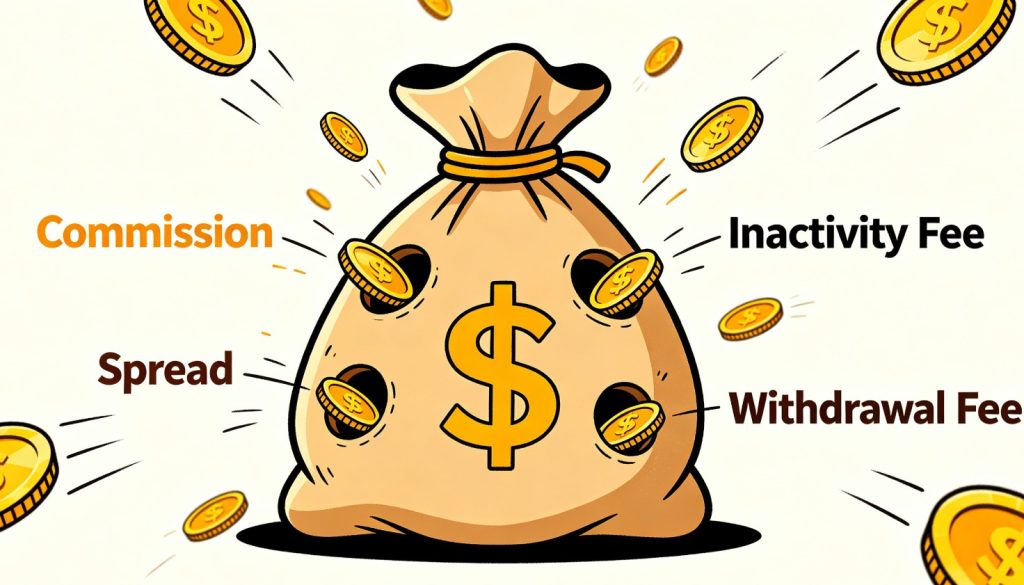
1. Commission Fee
This is the most direct and common cost. It is a charge applied every time you open or close a trade. It is usually calculated as a percentage of the total transaction value, or as a fixed amount per trade.
- Example: If a broker charges 0.15% commission and you trade $10,000 worth of stocks, you will pay $15 for that transaction.
- Note: Some brokers advertise “zero commission,” but they often offset this through other charges. Always check the full fee list to understand what you are really paying.
2. Spread
Common in forex, indices, commodities, and CFD trading. The spread is the difference between the price at which you can buy an asset (ask price) and the price at which you can sell it (bid price). It is effectively the broker’s built-in service charge.
- Impact: A wider spread means the market price must move further in your favor just to reach the break-even point. Smaller spreads are generally better for frequent traders.
3. Deposit and Withdrawal Fees
Some brokers charge fees when you transfer funds into your account or withdraw your profits back to your bank or wallet.
- Deposit fees: Often free when using bank transfers or major payment providers, but may apply for specific payment methods or currency conversions.
- Withdrawal fees: These can be a flat rate or a percentage of the amount being taken out. They can significantly reduce your net earnings if you withdraw small amounts often.
4. Inactivity Fee
If you open an account but do not make any trades or log in for a certain period — usually between 6 and 12 consecutive months — some brokers will deduct a monthly or annual fee from your remaining balance.
- Tip: If you plan to take a break from trading, check this rule in advance so you do not lose money unnecessarily.
5. Overnight / Swap / Rollover Fee
This fee applies when you hold leveraged positions open past the daily market closing time. It reflects the interest rate difference between the two currencies or assets involved in the trade. It can either be a cost you pay or a small amount you earn, depending on the direction of your trade.
- Effect: While it may seem small per day, these fees add up quickly if you keep positions open for weeks or months.
6. Data and Platform Fees
Some brokers charge extra for access to real-time market data, advanced charting tools, premium research reports, or professional trading platforms. Basic services are usually free, but more advanced tools may come at a cost.
7. Currency Conversion Fees
If you fund your account or trade assets in a currency different from your account’s base currency, a conversion fee — usually between 0.1% and 1% — will be applied to exchange the money at market rates.
⚖️ How Fees Affect Your Profits
It is easy to ignore small fees, but over time they have a surprisingly large impact on your overall returns. Here is a simple example:
Suppose you invest $10,000 and earn an average annual return of 10% over 10 years.
- With total fees of 0.5% per year: Your final balance will grow to approximately $25,937.
- With total fees of 2.5% per year: Over the same period, your final balance will only reach around $21,120.
A difference of just 2% in annual fees costs you nearly $4,800 in lost growth. This shows clearly that controlling costs is just as important as choosing the right assets or strategy.
✅ How to Choose a Broker With Fair Fees
To keep your profits protected, follow these practical guidelines:
- Demand Full Transparency: Reliable brokers will publish their complete fee schedule on their website or in the account terms. Avoid any broker that is vague or reluctant to explain their charges.
- Don’t Choose by Price Alone: Very low fees can sometimes mean poor customer support, slow trade execution, or less reliable services. Balance low costs with trust and reputation.
- Calculate the Total Cost: Do not focus only on commission rates. Add up spreads, withdrawal charges, conversion costs, and any recurring fees to get the real picture of what you will pay.
- Match Fees to Your Trading Style: If you trade frequently, low commissions and tight spreads will matter most. If you invest for the long term, one-time transaction fees are more important than overnight charges.
📝 Final Thoughts
Broker fees are a normal part of trading and investing — they are how brokers stay in business and maintain their services. The goal is not to find a broker with zero fees (which rarely exists), but to find one whose charges are fair, predictable, and suitable for your activity level.
Always remember: Every dollar or cent saved on fees goes directly to your net profit. Before opening an account, take a few minutes to review the full fee policy. It is one of the simplest yet most effective ways to ensure your money grows as planned.
Disclaimer: This article is for educational and informational purposes only and does not constitute financial advice, investment recommendation, or solicitation to trade. Trading and investing involve risk, including the possible loss of principal. Always conduct your own research and consider your financial situation before making any decisions.