
How to Choose the Right Forex Broker: A Beginner’s Guide
How to Choose the Right Forex Broker: A Beginner’s Guide The Foreign Exchange (Forex) market is the largest financial market in the world, trading over $7 trillion daily. But before you dive into buying and selling currency pairs, there is one crucial decision you need to make first: choosing the right Forex broker. Your broker […]
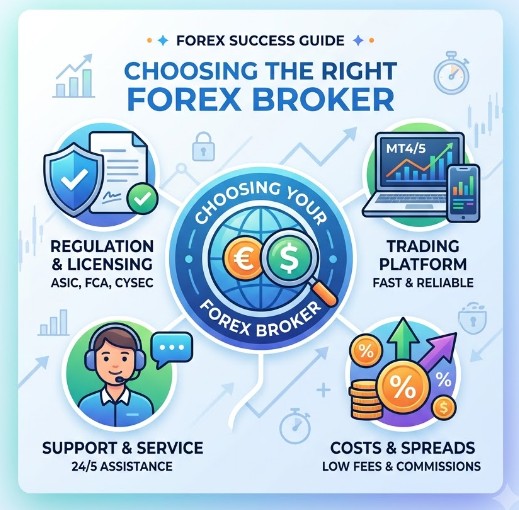
How to Choose the Right Forex Broker: A Beginner’s Guide
The Foreign Exchange (Forex) market is the largest financial market in the world, trading over $7 trillion daily. But before you dive into buying and selling currency pairs, there is one crucial decision you need to make first: choosing the right Forex broker.
Your broker is your gateway to the market. Picking a bad one can lead to high hidden fees, terrible execution speeds, or worse, losing your capital to a scam. Here is a practical blueprint to help you find a reliable partner for your trading journey.
1. Check Regulatory Compliance (The Non-Negotiable)
The absolute first step is to verify if the broker is regulated. Regulated brokers are legally required to keep your funds in segregated bank accounts, meaning they cannot use your money for their own operating expenses.
Look for brokers regulated by tier-one financial authorities, such as:
- FCA (Financial Conduct Authority) – United Kingdom
- ASIC (Australian Securities and Investments Commission) – Australia
- NFA / CFTC – United States
- Bappebti – Indonesia (if you prefer a local broker)
Warning: If a broker is registered in an offshore tax haven with little to no financial oversight, walk away. Protecting your capital should always be your top priority.
2. Understand the Costs: Spreads and Commissions
Brokers don’t provide their services for free. They make money through two primary pricing models:
- Spreads: The difference between the buy (bid) and sell (ask) price, measured in pips.
- Commissions: A fixed fee charged per trade, usually based on trading volume.
| Account Type | Spreads | Commission | Best For |
| Standard Account | Higher (e.g., 1.0 – 1.5 pips) | Zero | Beginners with small capital |
| ECN / Raw Account | Ultra-low (e.g., 0.0 – 0.3 pips) | Fixed fee per lot | Day traders and scalpers |
Make sure to look out for hidden fees, such as inactivity fees, or high withdrawal charges that can quietly eat into your profits.
3. Platform Usability and Execution Speed
In Forex trading, fractions of a second matter. A delay in execution can cause slippage—which is when your trade opens at a different price than the one you intended.
Ensure the broker supports robust, industry-standard platforms like MetaTrader 4 (MT4), MetaTrader 5 (MT5), or cTrader. Test their infrastructure by opening a free demo account first to check if the app or software runs smoothly without lagging.
4. Deposit and Withdrawal Efficiency
A great broker makes it easy to fund your account, but a trustworthy broker makes it just as easy to take your money out.
Before depositing real money, look into:
- Supported payment methods (Bank transfers, e-wallets, or local internet banking).
- Processing times (Deposits are usually instant, but withdrawals should ideally take no more than 1 to 2 business days).
Summary Checklist
Before you hit that sign-up button, run through this quick checklist:
- [ ] Is the broker regulated by a reputable authority?
- [ ] Are the trading fees (spreads + commissions) transparent and competitive?
- [ ] Does the platform execute trades quickly with minimal slippage?
- [ ] Is customer support responsive and available in your language?
Conclusion
There is no single “best” broker for everyone, but the right broker is one that offers safety, fair pricing, and excellent uptime. Take your time, test them using a demo account, and never risk real money until you are 100% comfortable with your choice.