
How to Set Up Moving Averages: The Professional Traders’ Approach
How to Set Up Moving Averages: The Professional Traders’ Approach The Moving Average (MA) is one of the most widely used and reliable technical indicators in trading. It helps smooth out price fluctuations, identify trend direction, and spot potential entry and exit points. While it seems simple at first glance, professional traders understand that choosing […]
How to Set Up Moving Averages: The Professional Traders’ Approach
The Moving Average (MA) is one of the most widely used and reliable technical indicators in trading. It helps smooth out price fluctuations, identify trend direction, and spot potential entry and exit points. While it seems simple at first glance, professional traders understand that choosing the right type, period, and configuration makes all the difference between a useful tool and a misleading signal. This article explains how to set up moving averages the way experienced traders do.
1. Understand the Main Types of Moving Averages
Before setting up, you need to know the two most common types used by professionals:
Simple Moving Average (SMA)
SMA calculates the average price over a specific number of periods by adding all closing prices and dividing by the period count. It gives equal weight to every price in the range. This makes it stable and easy to interpret, ideal for identifying long-term trends.
Exponential Moving Average (EMA)
EMA gives more weight to recent price data, making it react faster to price changes. Professional traders prefer EMA for short-to-medium term trading because it produces signals earlier than SMA, though it may also generate more false signals during volatile markets.
2. Choose the Right Period Settings
The period determines how sensitive the MA will be. Professionals select periods based on their trading style and time frame:
- Short-term trends: 9, 10, or 20 periods – Suitable for day trading and scalping; reacts quickly to price changes.
- Medium-term trends: 50 periods – The most popular period to confirm the main trend direction.
- Long-term trends: 100 or 200 periods – Widely used to identify major support/resistance and long-term market bias. The 200-period MA is considered a benchmark for the overall health of a market.
3. Practical Setup Methods
Here are the most trusted configurations used by professional traders:
Single Moving Average
Setup: Use one MA (usually 20, 50, or 200)
Rules:
✅ If price stays above the MA, the trend is considered bullish.
✅ If price stays below the MA, the trend is considered bearish.
Best for: Trend identification and filtering market direction.
Dual Moving Average Crossover
Setup: Combine a shorter-period MA and a longer-period MA
Example: 20 EMA + 50 EMA
Signals:
🟢 Golden Cross: When the shorter MA crosses above the longer MA – bullish signal.
🔴 Death Cross: When the shorter MA crosses below the longer MA – bearish signal.
Best for: Confirming trend changes and generating entry/exit triggers.
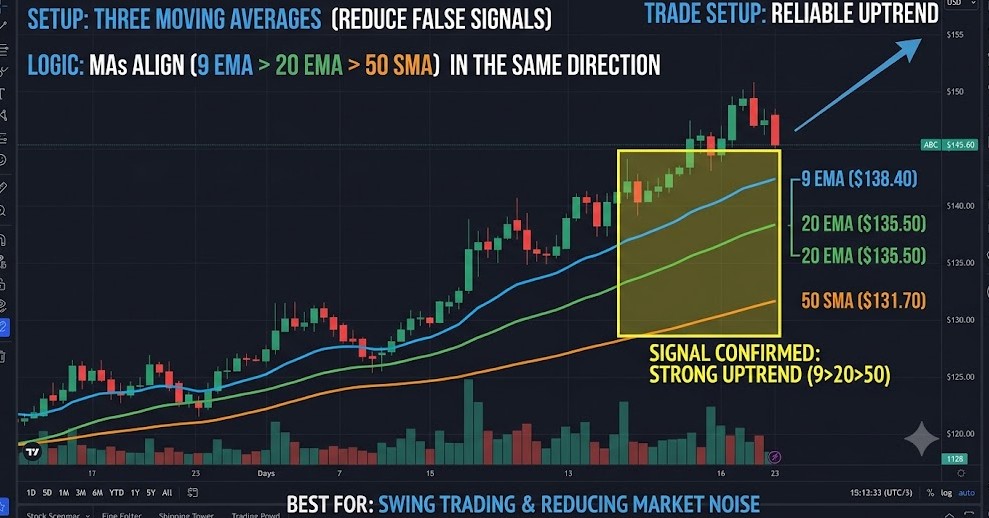
Triple Moving Average Combination
Setup: Use three MAs to reduce false signals
Example: 9 EMA + 20 EMA + 50 SMA
Logic: When all three MAs align in the same direction (shortest above middle, middle above longest), the trend is strong and reliable.
Best for: Swing trading and reducing market noise.
4. Adjust for Different Time Frames
Professional traders match MA settings to their preferred time frame:
- Day Trading (15min – 1 hour): 9 EMA, 20 EMA, 50 SMA
- Swing Trading (4 hour – Daily): 20 EMA, 50 SMA, 100 SMA
- Position Trading (Daily – Weekly): 50 SMA, 100 SMA, 200 SMA
5. Important Rules for Professional Use
- Never rely only on MA: Combine it with support/resistance levels, volume, or other indicators like RSI or MACD to confirm signals.
- Avoid using too many periods: More MAs do not equal better results; they often create confusion.
- Adapt to the asset: What works for stocks may need slight adjustment for forex, crypto, or commodities.
- Backtest first: Always test your chosen settings on historical data before applying them in live trading.
Conclusion
Setting up moving averages correctly is not about using complicated formulas or rare periods—it is about selecting the right type, matching the period to your trading style, and combining them logically. By following the methods used by professional traders, you can turn this simple indicator into a powerful tool for analyzing trends and managing risk.